Welcome Message
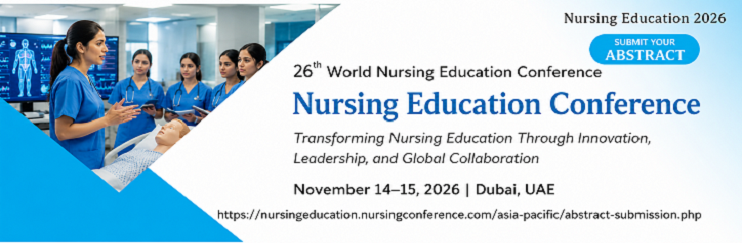
On behalf of the Organizing Committee, it is our great honour and pleasure to welcome distinguished scientists, academicians, researchers, nursing professionals, healthcare practitioners, educators, industry experts, students, and delegates from around the globe to the 26th World Nursing Education Conference, taking place on November 14–15, 2026, in Dubai, UAE.
The conference theme, "Transforming Nursing Education Through Innovation, Leadership, and Global Collaboration," reflects our commitment to advancing nursing education and healthcare excellence in an ever-evolving world. This prestigious gathering will serve as a dynamic platform for sharing ground breaking research, innovative educational strategies, emerging healthcare technologies, and best practices that are shaping the future of nursing and patient care.
World Nursing Education 2026 aims to bring together a diverse and multidisciplinary community of experts, scholars, practitioners, policymakers, and future healthcare leaders to exchange knowledge, foster meaningful collaborations, and explore solutions to the challenges facing nursing education and healthcare systems worldwide. Through inspiring keynote presentations, interactive discussions, scientific sessions, and networking opportunities, participants will gain valuable insights into the latest developments and future directions of the profession.
We believe that the collective expertise and experiences shared during this conference will contribute significantly to strengthening nursing education, enhancing clinical practice, and improving global health outcomes. Your participation is instrumental in making this event a remarkable success and in advancing the nursing profession on an international scale.
We warmly invite you to join us in the vibrant city of Dubai for two days of learning, collaboration, innovation, and professional growth. We look forward to welcoming you and creating an enriching and memorable experience together.
Welcome to the 26th World Nursing Education Conference 2026!
Scientific Sessions & Tracks
Track 01: Future-Ready Nursing Education
Future-Ready Nursing Education focuses on preparing nurses for the evolving demands of modern healthcare systems. This track explores innovative teaching methodologies, competency-based curricula, simulation learning, and digital education tools. Discussions will highlight strategies to strengthen critical thinking, clinical judgment, and professional competence. Participants will gain insights into educational excellence and workforce preparedness. The session encourages collaboration among educators, researchers, and academic leaders.
Track 02: Digital Health and Nursing Technology
Advancements in healthcare technology are transforming nursing practice worldwide. This track examines digital health solutions, telehealth services, wearable devices, electronic health records, and smart healthcare systems. Participants will explore how technology enhances patient safety, clinical efficiency, and healthcare accessibility. The session also addresses implementation challenges and future opportunities. Innovative case studies and emerging trends will be highlighted.
Track 03: Artificial Intelligence in Nursing
Artificial Intelligence is revolutionizing healthcare delivery and nursing practice. This track focuses on AI-powered decision support systems, predictive analytics, robotics, and intelligent patient monitoring. Experts will discuss practical applications and ethical considerations of AI in healthcare. The session aims to showcase how technology can improve patient outcomes and clinical efficiency. Future innovations and research opportunities will also be explored.
Track 04: Nursing Leadership and Professional Development
Leadership plays a critical role in strengthening healthcare organizations and nursing practice. This session focuses on leadership development, workforce empowerment, mentoring, and strategic decision-making. Participants will learn how effective leadership contributes to improved patient outcomes and organizational success. Discussions will also address professional growth and career advancement opportunities. The track is designed for emerging and experienced nurse leaders.
Track 05: Global Health and Healthcare Innovation
Global healthcare systems face evolving challenges that require innovative solutions. This track explores healthcare accessibility, population health, disease prevention, and international healthcare initiatives. Experts will share best practices and successful models from around the world. Participants will examine strategies that promote sustainable and equitable healthcare delivery. The session encourages global collaboration and knowledge exchange.
Track 06: Advanced Clinical Nursing Practice
Advanced nursing roles are becoming increasingly important in modern healthcare. This track highlights specialized clinical practice, patient assessment, evidence-based interventions, and advanced care delivery models. Discussions will focus on improving patient outcomes through clinical expertise and innovation. Participants will explore opportunities for expanding nursing responsibilities. The session promotes excellence in advanced nursing practice.
Track 07: Mental Health and Emotional Wellbeing
Mental health is a growing global healthcare priority. This track addresses psychiatric nursing, behavioral health, stress management, crisis intervention, and patient-centered mental healthcare. Experts will discuss innovative approaches for supporting mental wellbeing across diverse populations. Participants will explore evidence-based strategies for prevention and treatment. The session promotes holistic and compassionate care.
Track 08: Community and Public Health Nursing
Community health nurses play a vital role in promoting wellness and preventing disease. This track focuses on health education, community outreach, public health initiatives, and population-based care. Discussions will explore strategies for improving health outcomes at local and global levels. Participants will learn about innovative community health programs. The session highlights the importance of preventive healthcare.
Track 09: Emergency and Critical Care Nursing
Emergency and critical care nurses are essential in life-saving situations. This track explores trauma management, emergency preparedness, intensive care practices, and rapid response systems. Experts will discuss advances in critical care technologies and patient management. Participants will gain insights into delivering high-quality care during emergencies. The session focuses on improving patient survival and recovery.
Track 10: Women's Health and Midwifery
Women's health requires specialized care throughout different stages of life. This track covers reproductive health, maternal care, gynecological nursing, midwifery practices, and preventive healthcare. Discussions will focus on improving maternal and neonatal outcomes through evidence-based care. Participants will explore innovations in women’s healthcare services. The session supports comprehensive and patient-centered care.
Track 11: Pediatric and Neonatal Nursing
Children and newborns require specialized nursing knowledge and skills. This track explores neonatal care, pediatric healthcare, developmental disorders, and family-centered nursing approaches. Experts will discuss advancements in child health promotion and disease management. Participants will learn about innovative strategies that improve pediatric outcomes. The session emphasizes quality care for young patients.
Track 12: Geriatric and Healthy Aging Nursing
The growing elderly population presents new healthcare opportunities and challenges. This track focuses on healthy aging, chronic disease management, dementia care, rehabilitation, and long-term care services. Discussions will explore innovative approaches to supporting older adults. Participants will gain insights into age-friendly healthcare practices. The session promotes dignity and quality of life in aging populations.
Track 13: Oncology and Palliative Care Nursing
Cancer care continues to evolve through research and clinical innovation. This track addresses oncology nursing, symptom management, supportive care, survivorship programs, and palliative care services. Experts will discuss patient-centered approaches that improve quality of life. Participants will explore advancements in cancer treatment and nursing care. The session promotes compassionate and comprehensive care.
Track 14: Cardiovascular Nursing Excellence
Cardiovascular diseases remain among the leading causes of mortality worldwide. This track explores prevention, diagnosis, treatment, rehabilitation, and nursing interventions related to heart health. Participants will learn about advancements in cardiac care and patient monitoring. Discussions will focus on improving outcomes through evidence-based practice. The session highlights innovations in cardiovascular nursing.
Track 15: Infection Prevention and Patient Safety
Patient safety is a cornerstone of healthcare quality. This track focuses on infection prevention strategies, healthcare-associated infections, risk reduction, and safety culture development. Experts will discuss best practices for maintaining safe healthcare environments. Participants will explore approaches that minimize complications and improve patient outcomes. The session supports excellence in quality care.
Track 16: Nursing Research and Evidence-Based Practice
Research is essential for advancing nursing knowledge and healthcare outcomes. This track provides a platform for presenting innovative studies, clinical findings, and evidence-based interventions. Participants will discuss methods for translating research into practice. The session encourages collaboration between researchers, educators, and clinicians. Emerging trends and future research directions will also be explored.
Track 17: Simulation and Clinical Skills Training
Simulation-based education has transformed nursing training worldwide. This track explores advanced simulation technologies, virtual reality, clinical skill development, and competency assessment. Participants will learn how simulation enhances learning experiences and patient safety. Discussions will focus on innovative educational strategies. The session promotes excellence in clinical training.
Track 18: Nursing Informatics and Data Analytics
Healthcare data plays a vital role in improving patient care and decision-making. This track examines nursing informatics, health information systems, data analytics, and digital documentation. Experts will discuss how technology supports clinical practice and operational efficiency. Participants will explore future trends in healthcare information management. The session highlights innovation through data-driven healthcare.
Track 19: Sustainable Healthcare and Environmental Health
Environmental factors significantly impact public health and healthcare systems. This track focuses on sustainable healthcare practices, climate change, environmental health risks, and green healthcare initiatives. Discussions will explore the role of nurses in promoting environmental responsibility. Participants will learn strategies for building sustainable healthcare environments. The session supports global health sustainability goals.
Track 20: Healthcare Quality Improvement
Continuous improvement is essential for delivering high-quality healthcare services. This track explores quality assurance, performance measurement, patient satisfaction, and healthcare excellence initiatives. Experts will share successful quality improvement projects and best practices. Participants will examine methods for enhancing patient outcomes and organizational performance. The session promotes a culture of continuous improvement.
Track 21: Cultural Competence and Inclusive Care
Providing equitable healthcare requires understanding diverse cultural backgrounds and patient needs. This track focuses on cultural competence, health equity, diversity, inclusion, and patient-centered communication. Discussions will highlight strategies for reducing healthcare disparities. Participants will gain insights into delivering respectful and inclusive care. The session supports healthcare excellence for diverse populations.
Track 22: Nursing Ethics and Healthcare Policy
Ethical principles guide nursing practice and healthcare decision-making. This track explores professional ethics, healthcare legislation, patient rights, policy development, and regulatory challenges. Experts will discuss contemporary ethical issues affecting healthcare systems. Participants will gain a deeper understanding of accountability and advocacy. The session promotes ethical leadership in nursing.
Track 23: Telehealth and Remote Patient Care
Telehealth has expanded access to healthcare services across the globe. This track examines virtual consultations, remote monitoring, digital communication, and telehealth implementation strategies. Participants will explore innovative approaches to improving patient engagement and continuity of care. Discussions will address benefits, challenges, and future developments. The session highlights the growing role of virtual healthcare.
Track 24: Interprofessional Collaboration in Healthcare
Collaboration among healthcare professionals improves patient outcomes and healthcare efficiency. This track focuses on teamwork, communication, integrated care models, and multidisciplinary practice. Experts will share successful collaborative approaches in healthcare settings. Participants will learn strategies for strengthening professional partnerships. The session promotes coordinated and patient-centered care.
Track 25: Resilience, Wellness and Workforce Sustainability
The wellbeing of healthcare professionals is essential for sustainable healthcare systems. This track addresses resilience, stress management, burnout prevention, work-life balance, and workforce retention. Discussions will focus on creating supportive work environments and promoting professional wellness. Participants will explore strategies for maintaining personal and organizational resilience. The session supports a healthy nursing workforce.
Track 26: Future Trends and Innovations in Nursing
This track explores emerging trends and breakthrough innovations shaping the future of nursing and healthcare. Topics include next-generation technologies, personalized care models, healthcare transformation, and future workforce needs. Experts will discuss opportunities and challenges facing the profession. Participants will gain valuable insights into upcoming developments and global healthcare trends. The session inspires innovation and forward-thinking leadership.
Market Analysis
The global nursing education sector is experiencing significant growth, driven by increasing demand for qualified healthcare professionals, advancements in digital learning technologies, and ongoing investments in healthcare workforce development. The global nursing workforce reached approximately 29.8 million professionals in 2023, yet a shortage of nearly 4.1 million nurses is still projected by 2030, creating an urgent need for expanded nursing education and training programs. This growing demand is accelerating investments in academic institutions, simulation-based learning, workforce development initiatives, and continuing professional education.
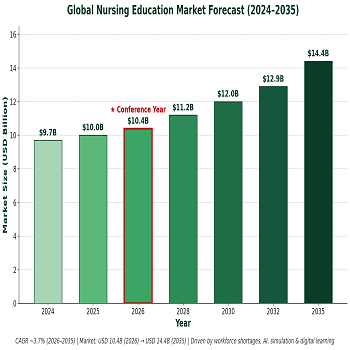
The Nursing Education Market is estimated to exceed USD 10.4 billion in 2026 and is projected to reach approximately USD 14.4 billion by 2035, reflecting steady growth driven by expanding healthcare infrastructure, population growth, and increasing enrollment in nursing programs worldwide. Educational institutions are increasingly adopting competency-based curricula, virtual learning platforms, and advanced clinical training models to address workforce shortages and improve healthcare outcomes.
Nursing Education Market Trends
Artificial Intelligence Transforming Nursing Education
Artificial Intelligence (AI) is reshaping nursing education through intelligent tutoring systems, virtual patient simulations, predictive learning analytics, and personalized educational experiences. AI-driven platforms help students develop clinical decision-making skills while enabling educators to monitor performance and customize learning pathways. The integration of AI is expected to become a major driver of nursing education innovation over the coming decade.
Growth of Simulation-Based Learning
Simulation technology has become a cornerstone of modern nursing education. High-fidelity simulation laboratories, virtual reality training environments, and immersive clinical scenarios allow students to gain practical experience in a safe learning environment. The global medical simulation market was valued at approximately USD 1.9 billion in 2025 and is projected to grow substantially through 2033, reflecting increased adoption across nursing and healthcare education institutions.
Expansion of Digital and Hybrid Learning Models
Educational institutions worldwide are increasingly implementing online and hybrid learning programs to improve accessibility and flexibility. Digital classrooms, remote clinical learning tools, and virtual collaboration platforms are enabling nursing students to access high-quality education regardless of geographical location. These approaches support lifelong learning and continuing professional development for healthcare professionals.
Focus on Workforce Development and Retention
Healthcare systems globally are investing in nursing education to address workforce shortages, improve retention, and strengthen healthcare delivery. Educational capacity expansion, leadership development programs, advanced specialty training, and continuing education initiatives are becoming key priorities for governments, healthcare organizations, and academic institutions.